My heart belongs to no man,
but to the wrathful briars of a spurned goddess,
and with my breath like flame,
I speak her name,
and make manifest Her fury.
---
I woke today, just before 4:00 am to the pre-twilight break of a single crack of thunder and a rain storm that had settled in so silently that without the thunderbolt, I would not have been shaken awake. As we reflect on the nature of our own inquiry, the value of our labor, and our intellectual community, I cannot but help think of the heat dome we’re facing in Central Texas and the idea that “it takes a storm, but with time and good mindfulness, we pass through.” My community cats, curled up in tight balls below the eves of my porch and the single deck light casting rain shadows on my concrete slab remind me that we are better to do this work in community, because community is the goal that we have worn down our fingerbones to build. It being now 4:10 am, the coffee is also helping motivate this project.
It is hard to imagine that any of us are unaware of the exigency for this piece of writing, but I will add to it, that it was recently one of my dear professor’s birthday, and I would have risen to the encomium regardless. That said, sometimes we find our writing—and the value of seizing kairos—to be multi-fold.
I was already reflecting on the rich cultural tradition of my intellectual upbringing, as earlier this week, despite the deep bustle of the alt-ac staff job I am working, and the courses I am perennially planning in the back-and-front of my mind, I, like many of us, began to doomscroll through the algorithm, violently pointing my sharp mind at small-form content (which I do think is part of the problem that we find ourselves in with the current geopolitical moment, but that is a different essay or essay series that I am not equipped to write) when I saw Miriam Schoenfield discussing belief in a post for The Institute of Art and Ideas.
It took me on a deep stroll through my own academic record, because I recalled—immediately upon seeing that post—that Professor Schoenfield gave me the lowest grade I have ever earned in philosophy for the work that I did not do in my theories of epistemology class. The jaunt took me—and shook me—as I recalled that was the semester in which I leant back and spoke fire into the universe and said “yeah I can do it” despite my academic advisor(s) telling me that my plan was profoundly stupid (in kinder words than that). After tackling logic (not easy) and my first upper-level Rhetoric & Writing course, I strolled into Andrea’s office and said “what is the maximum amount of rhetoric I can attempt this semester? I have ideas and I need to shake them out.” The semester in which I earned the B+ in Professor Schoenfield’s theories of epistemology, I was also in nine hours (three seminars) of upper-division rhetoric, all of which were writing intensive (because of course) and so was the epistemology, and looking at the flag system, now gone, it was the only semester I attempted four writing flags. I should have taken Susan and Andrea’s “uhhhhh, you could do that” as more of a ‘no’ than I heard, and I took their apprehension as a challenge, not as a warning.
So it turns out that they were right.
In the fall of 2013, after walking out of a 9-credit hour summer, I stepped back into Parlin Hall with Dan, where he taught me that there are rarely stupid ideas and that people have been asking about the things I found novel for a long time. I felt edgy that semester and posed, with a pitiful lack of knowledge, “I bet you couldn’t rhetorically analyze a building?!” and he sat there, with a sort of quiet and quizzical candor, reflected for only half of half a moment, and said “Yeah but you can and people have been doing that for a long time, why don’t you go read about it?” Bless him, he is patient. That set me on the path of monument and memory work I still take up today.
After walking out of Rhetoric and Narrative, I walked into Davida’s class where she taught me that the only low-value writing work was unexamined writing work, and I have never thought as much about lexcinography as I did in her advanced writing course with the Fahnestock text, of which I keep one handy in my home and campus office. I assigned that “Write it three times” assignment in my lower-level ENG 102’s and 215’s, and I swear it moved the needle on my evaluations by nearly a whole point, and it was worth it for me to struggle through that assignment, and it was worth it for my students to join me in that grapple so many years after I did it myself.
And after walking out of Advanced Writing, I walked into Rasha’s class on rhetorical historiography, and I swear to rights, I still am profoundly stricken by the idea that people do not have the sense that history is written by someone, despite every pithy freshman history major or advanced high school student spitting the Winston Churchill quote—which I learned today before sunbreak that it is not a Napoleon Bonaparte quote—but that it is instead disciplinary inquiry and history of histories and community work that results in something like the Bizzell and Herzberg, and she was already weaving in criticisms of that history and nudges for past and future consideration, some of which are in the current edition, and all of which leant me pause to think. I was almost insulted at the time that she turned to me in her office, again, very early in my undergraduate career, and with a quitet compassion, told me that the library’s copy was insufficient. She told me that as a rhetoric and writing major who was fixated on the idea of graduate study, I needed to buy my own. Like the Fahnestock, I have a copy in both offices. The only other of those resources that I keep in both offices is the Jasinski Sourcebook that Trish advised me keep close enough, and I cannot tell you how much a student’s eyes light up when I give them Dan’s nudge that “No, that exists, do you want to see what the Sourcebook says about it?”
And then after walking out of Rhetoric Retold, I walked into epistemology, where if you cannot tell by now, I was overwhelmed with new ideas, and learning about old ideas for the first time, and writing about all of it all the time. Professor Schoenfield denoted a B+ on my transcript, but it was the kind of “graduate level B+” you get where you’re supposed to read into that a lot more and take more deeply to heart the advice you got in the writing feedback. And it was well deserved, and the feedback was profoundly good, but the advice I got, which I still think about now (which I think means it works) is “you should think about this a little more.” That gentle encouragement, which felt hard at the time, was from a world renown epistemologist telling me that I read the world renown epistemology we read as a class, and then I did not think about it enough. I did not know. And I know now, I did not believe—with or without justification—that she was right, and she was, and here we are.
I never took more than three writing courses at a time after that, and I did not earn less than a full A on any (even thesis, which I still think JR and Casey were perhaps too kind to me—but that kindness paid out several-fold over nonetheless).
If you read the headnote for the DRW, and it was certainly there that semester, it reads “Students are discouraged from taking more than six semester hours of coursework in rhetoric and writing in a semester. No student may take more than nine semester hours of coursework in rhetoric and writing in a semester.” And my “solution” to this “problem” was to instead take additional upper-division writing in another department? Graces preserve us all, my heart goes out to the strong women who advised me.
I learned a lot that semester about workload and self-acceptance as an academic (I did not use this word for it at the time), and the advice we get and the advice we give and the communities we build with our sweat and toil, and I think I am better for it all, but especially the ‘B+’ because it gave me just enough pause to reconsider—which was literally the point that Professor Schoenfield was trying to get us to see the whole time.
While scholars move in and out of favor through time, or move up and down in prominence, but I still think about the parlor metaphor to this day. In my teaching practicum for Arizona State, many of my friends and colleagues heard it for the first time in the sun-broken summer of 2016. I was privileged to have heard it four years before. And thinking now, by 2013 my oar was already deep.
That was not the work of any one thoughtful and kind professor, but the deep history of scholars in philosophy and English and rhetoric caring for the ideas (and sometimes lack thereof) that students enter the classroom and the people who enter the classroom with or without those ideas.
And that work, for me, did not begin when I walked into the yes-still-painfully-green walls of Parlin Hall or up the stairs that are still-just-the-wrong-height in Waggener. It began earlier, and it began deeper.
Growing up in Austin where I could spit one direction onto campus and spit another direction onto the capitol grounds, I could have sworn that I was born with a Lone Star Flag in one hand and the gladius libertatis in the other. I grew up, not in the shadow of intellectual community (my father was also a professor, that had a lot more to do with it than I let on, here), but in the echo of it. I grew up reading, already critically, the bible and the Politeia, such that when I found myself in honors-level “Jerusalem and Athens” (Mr. Dempsey is also profoundly patient) four years after leaving Catholic school, I realized I had been raised by Jesuits and theologians, not just dogmatics, and I knew doxa and enthymeme and all kinds of other argumentative structures that, when even Linda taught me “them for the first time,” I had already gotten many of them in high school sophomore-level “Christology” which I could tell you now, they should just call that class “Logic and Argumentation (in Defense of the Body of Christ)”. The name as it stands is not misleading, but SMCA can do some heavy lifting with teaching those students the value of the pedagogy with a slightly corrected naming schema.
And at the Catholic school where I was raised and looked into the eyes of truth—perhaps for the first and certainly (hopefully?) not for the last time—I was already watching Aronofsky and Linklater (and shout out to the [interim] dean of my college, by the way—RTF is not the only space with movie stars). And I was pulling together all of these rich histories, these tapestries of intellectual culture (and quasi-intellectual culture) that before I entered university for the first time, I must have used the words ‘substrate’ and ‘axiom’ more times than I wish to be able to count, compared to folk my age.
I had a terrible attendance issue that early because I was so unenthusiastic about going to class to learn about some thing I wish I paid more attention to at the time, but I would wind up in Catholic “Saturday school” (just call it weekend-detention) and would by-rights be broken out by whichever teacher needed a hand doing something such that my psychology-and-theatre teacher would teach me how to hold a hammer and use an electric drill while dispensing wisdom about the human psuche and ancient Greek contexts that when we read Sophocles and Chekhov or went to Texas Forensics and then I went to university, I had some deeply devastating quips about different perspectives that no one my age was really ready for.
Beyond that I studied with folk so passionate about church history and actual theology beyond “knowing what it says” in there that I had teachers who would engage with me intellectually as I posed some “stupid” question about images of God as a reflection of light like moon-shadows in some way to get at the idea that life is animus made possible by intersecting layers woven together by the Holy Ghost in a way that helps us make sense of the fabric of our world(s). I did not realize it at the time, but I inadvertently stumbled upon the problem that Isaac Newton and George Barkley played intellectual badminton over the fabric of beingness and perception in 1710, such that I took up arms in a schism-level debate as I pitched something that I called at the time “oculum obscurum deorum” and through some Cicero in there for good measure.
I also did not realize it in the bleary-eyed morning of detention that day, but I sat there with someone so compassionate and patient and understanding, that she paused and nodded and gave me even better ideas to think about the trinitarian unity of God, tripartite being more broadly, and the problem of evil.
And these aren’t just teachers, these folk were and are educated by the brightest minds of our time and treated ‘thought’ and ‘mind’ as legitimate, deep exercise in living good lives: master’s degrees, doctorates, service learning, world traveling, return-to-Texas-to-speak-truth-and-ask-questions type folk to serve the community. By blood and nails, my literature and creative writing teacher and I shared the same advisor at UT Austin. We are literally (and maybe literarily) in the same tradition. My graduate advisor’s graduate advisor’s graduate advisor was the man who stood in front of the room at prompted me to reflect on Apuleius and the Encomium of Helen and Phaedrus and corrected me, very very gently when I got the conjugation of ‘stoae’ wrong for whatever mock-up dialogue I wrote for Sophism and Invention, and he had been teaching those texts for decades when he told me “that’s a good idea—work with that” as though I had any right to be in the room. And I did. Early in my graduate career, my advisor asked me about his teaching style and I realized, having fixated on pedagogy as one of my goals, that I had good attitudes and the language to discuss the nature of teaching because of all of those people.
They are not just teachers, but they are teachers at work toward justice.
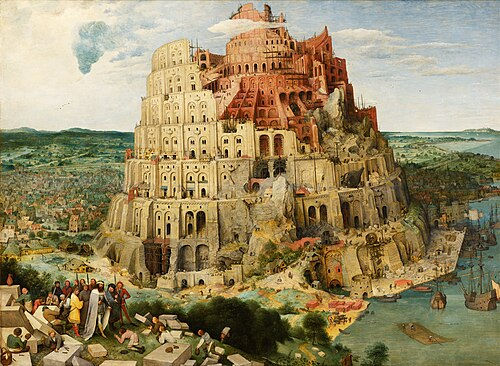
Weaving together this reflection on the nature of my education, which many of you know I value very highly, and to get at that idea of justice in doing the work, I want to share an idea I have returned to over a long span of time about biblical metaphor versus biblical literalism: I was thinking about the acts of men and acts of the gods in relation to the historicized stories of Jericho and Babel. They take up different roles in biblical history, and I am still formulating my full ideas of Jericho—but I think it is a kind of metaphoric counterpart to the story of Babel in Genesis. Both of them, as you may begin to guess, deal with logoi and their place in human nature and culture.
In the story of Babel, and cultural analogs, at least in the way that I read them, is not as much about hubris and folly—I find that more in recants of the gilded calf—but about fear. The lord of the jews, in seeing the peoples of the world construct this great tower in Shin’ar, separates out language and culture to make it so we can not conform to reach the heavens themselves. I am neither a sociologist, nor an anthropologist, nor a linguistics scholar, and do not plan to read into those parts of the story. But I am a scholar of story. The god of the jews sees the peoples rolling up, potentially to astrum ultra itself, and says “Nope.” Why? Fear.
And now, we are many peoples and not one people. But we share the stories. Over the span of thousands of years, across geographies and cultural climates, there is a kind of etiology of why we do not stand, so collectively, as one. I don’t think we need to, but by sharing story, even this story which populates in all kinds of religious texts even well beyond the Medieval, we stand outside of time and matter, and beside campfires or in classrooms we do the work of making sense of living in community. In no small way, I use this space and this network to remain connected to the people who are driven and determined to do the work and to the people who have inspired me—and continue to inspire me—to do the work.
Much earlier, and this is well beyond a jaunt or a ramble, I alluded to the potential dissolution of one of our most critical, most important academic and professional organizations. I see my friends, my mentors, my scholastic siblings, my neighbors, and my teachers deeply distraught over the disrespect of our time, our unity as a polity, and our being engaged in the work. And I do not ask why they and we are sad and hurt or angry, but I will ask why is this action being considered. We will find more information and data in time, and soon I hope, but as we draft our letters and pull on our coats and tunics and get out there to do the work, I hope we all, as you have all inspired me: ask “Why?”
Why?
Fear.
Composition and writing, as language, which is maybe not unique to humans or us as a discipline, but it is the work we rise to again and again and again and again and again, because it makes the difference—which all of you know.
This is not a call to be so totally united, as many of the best scholars at work today are still at work thinking of the value and necessity of disagreement. But I propose that we weave together a story that outlasts our human sense of the scale of time. Because that is the tradition we are in.
Our pedagogies are woven from the fabric of every lesson we have learned—good or bad—and learned well or not, from every teacher who put us on the path we pave.
Oar or hammer or pen or plume or keystroke. We go back to the work. And we do the work to build, sustain, maintain, support, and nourish the communities that have done so to us, and for us, and whom we are.
Be angry.
Be mad as hell.
But remember is it the logoi that shake not the foundations of professional organizations or the cities of humankind.
As we speak truth to power, we will shake the foundations of the heavens themselves, and put fear in the hearts of gods.
That is what we are good at.
Because we dedicate ourselves to our students and to our teachers and to giving life a good shake by looking close—by listening—and by encouraging ourselves and each other to keep going, and to pose good questions—even and especially when others are afraid of the answers.
I have opted not to tag anyone, but you all know that you are all here. So, please share with each other as you deem appropriate.
Warmly, in reflective fury and candor,
David
—Rhetorica est fundamentum civitatis—
Image accessed at: https://en.wikipedia.org/wiki/The_Tower_of_Babel_(Bruegel)